I’ve published a lot of books at this point, and every once in a while my mind turns to audiobooks.
I haven’t gone there because the level of effort (and, potentially, financial commitment) is high. That is until now.
What I had been thinking of doing is cloning my voice and letting an AI take the wheel and do the narration of my books, but as I dove back in recently, I stumbled on Spoken.press.
This site does full-cast audio narrations using AI and it does it for a reasonable price. Far, far less than what you would pay humans. And it’s pretty smart. It analyzes your story, does the preliminary casting of the voices, and lets you act as a director of the production and tweak things here and there.
It’s got quirks (like getting it to pronounce some words correctly, looking at you “aikido”), and it’s not perfect, but it’s surprisingly good.
They also advertise this as ethical AI, which helps on the moral side.
As an aside: I suspect “ethical AI” is similar to “free range eggs” and “green energy” in that it is a step in the right direction, but not perfect, and you are best off with third party certification (flawed though it may be). I don’t think there is such a thing for AI, but I appreciate that Spoken is making the effort and the narrators they used to train are getting compensated.
The Story
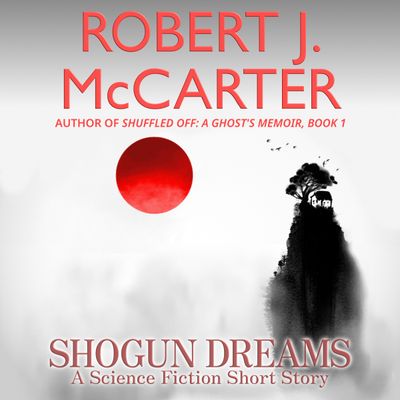
I’m starting small with a short story for financial and time reasons. I want to see this work, see what other people think. I’m starting up my Story of the Month program and tried it out on the first story, “Shogun Dreams.”
The Process
Using Spoken was actually quite fun at first. It did a thorough analysis of the story, came up with the genre, a blurb, keywords, found all the different characters, and create a lexicon of words it wasn’t sure how to pronounce.
Then came casting where you can review the selections that AI made for your characters. Here you can change, tweak, or find other narrators.
Next comes the “directing” part. Here you listen to the audio with the full cast of characters and tweak away. I found a couple of small problems in the text, and wrestled with getting pronunciation right on some Japanese words used in the story.
It should be noted that it took a while to wrestle with the 5% the AI did not do a good job of. Quite a while. It’s not like you can just throw your text in and have an audiobook a few minutes later. It has to be reviewed, changes are going to be needed. It is still a time commitment.
On top of that there were some bugs in the UI and a learning curve to take on, some random “pops” that kept occurring in the audio, and a few other annoyances. My 25 minute short story took 6 or 8 hours.
To be fair, I picked a hard story to start with and was new to the system, but I would expect this to take several times the length of the audio in a best-case scenario (so an 8 hour audiobook of a novel would take around 15 to 20 hours to create with Spoken).
Is it Any Good?
The short answer is, yes. It’s quite good.
The longer answer is similar to most any use of AI I’ve done: it’s good most of the time, but sometimes it’s pretty terrible.
Getting it to pronounce “aikido” correctly and the same way throughout was a real chore, and there is one passage with high emotion I just couldn’t get what I wanted out of it.
It’s not perfect, but pretty amazing.
But… But… What About the Moral Implications?
If we push aside the general AI concerns (address in this post), what we are left with is the fact that this technology will take work away from human narrators. And it will. I can’t see how it won’t.
But it will do something else. It will allow many stories to get a full-cast audio treatment that wouldn’t have it otherwise.
Let’s take “Shogun Dreams,” for example. This is a 3,600 word short story, and without AI there wouldn’t be a full-cast audio version of it, ever. There wouldn’t even be a single-narrator version either. It just wouldn’t happen.
And, at my level, none of my books would get a full-cast treatment, it just wasn’t economically viable before this. That doesn’t hold for the big names, but it does for most of us.
AI is, clearly, a disruptive technology, and as such it will take work away and also enable things that just wouldn’t happen before.
I think honesty is important here. If the narration is done by AI, that should be clear. That will drive some people away and attract others.
What’s Next?
For me, audio is untapped, and another way to reach “readers.” How far or how deep I will go into it, I just don’t know yet.
For now, I’m not at the level where I can justify spending weeks of my time and lots of funds to narrate one of my novels the traditional way, but I can probably justify a day or two to get a full-cast AI narration with a clone of my voice as the narrator.
I think I’ll do a few more short stories and see what that feels like. I’ll be posting the audio version of “Shogun Dreams” here soon. Stay tuned.
Update The full-cast audio version of “Shogun Dreams” is now available now on Patreon.
Leave a Comment